Tryhackme: AD: Basic Enumeration
Learning Active Directory reconnaissance on a Windows DC (TryHackMe-style)
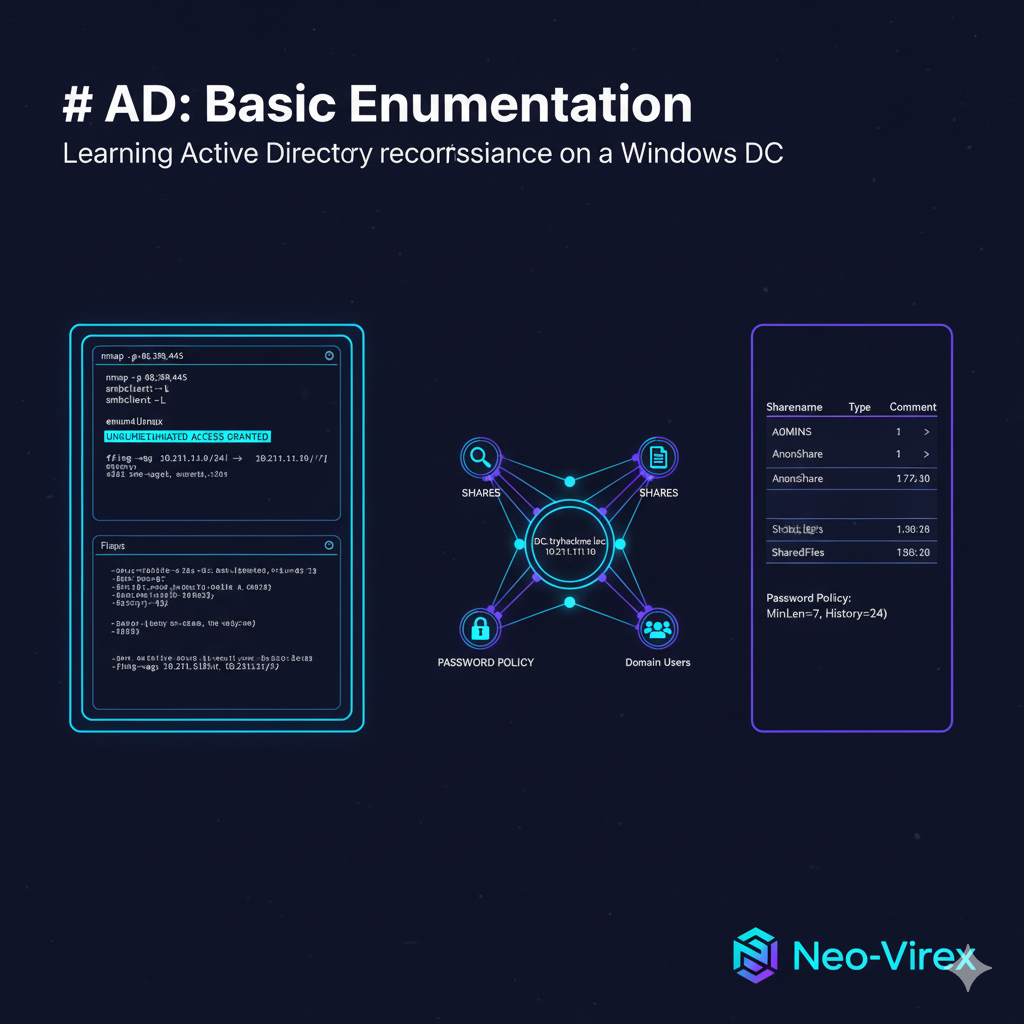
AD: Basic Enumeration
Learning Active Directory reconnaissance on a Windows DC (TryHackMe-style)
Neo-Virex
I attacked a small AD lab to practice enumeration. After discovering three live hosts I focused on the Domain Controller (DC). Using basic network scanning and unauthenticated SMB/LDAP queries I was able to: enumerate shares, download readable files (including a small flag), enumerate 30+ domain users and groups, and extract password policy details — all without valid credentials. This is a classic reminder: misconfigured shares and overly-informative services make AD environments easy to map.
Why this lab matters
Active Directory is the backbone of many corporate Windows environments. Attackers spend a lot of time in the reconnaissance phase: mapping services, finding shares and files, and collecting usernames before trying credential-based attacks. This lab demonstrates how much information you can get without authenticating at all, and why preventing trivial information leakage is critical.
Lab overview — what I attacked
- Target: Windows domain controller (identified as
DC.tryhackme.loc) on10.211.11.10. - Key services discovered: Kerberos (88), LDAP (389), SMB (445), RPC/NetBIOS, RDP (3389).
- Goal: Practice enumeration: list shares, retrieve readable files, enumerate domain users/groups and extract password policy — all unauthenticated.
Lab setup & connectivity
From the attacker machine I confirmed network routes and discovered live hosts on the target subnet using fping:
1
2
3
# quickly list live hosts
fping -agq 10.211.11.0/24
# -> 10.211.11.10, 10.211.11.20, 10.211.11.250
I focused on 10.211.11.10 — it returned many AD-related services (Kerberos, LDAP, SMB, RPC, RDP) in an nmap service scan. Key ports: 88, 135, 139, 389, 445, 3389, 5985 (Windows DC fingerprint).
High-level methodology
- Quick host discovery (fping).
- Service discovery (
nmap -sV -sCon interesting ports). - SMB exploration (
smbclient,smbmap) to check anonymous access and list shares. - Run AD-focused enumeration tools (
enum4linux,enum4linux-ng,rpcclient) to gather domain users, groups, policy and share mapping. - Read accessible files from shares (flag, stories) and collect usernames for further attacks (password spraying, Kerberoasting, brute force, etc.).
Important findings (what I actually discovered)
- Open AD services: LDAP (
389), LDAPS (636), Kerberos (88), SMB (445), RPC/NetBIOS. Nmap identified the host as Windows Server 2019 Datacenter with FQDNDC.tryhackme.loc. - Anonymous SMB allowed (null session):
smbclient -L //10.211.11.10 -Nandsmbmap -H 10.211.11.10showed several shares and allowed anonymous listing ofSharedFiles,AnonShare, andUserBackups. - Files retrieved:
Mouse_and_Malware.txtfromSharedFilesand a smallflag.txtplusstory.txtfromUserBackups. The flag file was downloadable via anonymous SMB. - Domain/user enumeration (unauthenticated):
enum4linux/enum4linux-ng/rpcclientrevealed ~32 domain users (e.g.,administrator,krbtgt,sshd,gerald.burgess,katie.thomas, etc.) and many domain groups includingDomain Admins,Enterprise Admins,Domain Users. This was all visible without a valid domain credential. cite - Password policy: Minimum length 7, complexity enabled, password history 24 — captured with
rpcclient/crackmapexec. This helps tailor password spraying wordlists and timing to avoid lockouts.
Key commands (cheat-sheet)
Run these to reproduce the main discovery steps:
1
2
3
4
5
6
7
8
9
10
11
12
13
14
15
16
17
18
19
20
21
22
23
# find live hosts
fping -agq 10.211.11.0/24

# quick service scan on a host
nmap -p 1-65535 -sV -sC 10.211.11.10

# targeted nmap on AD ports
nmap -p 88,135,139,389,445 -sV -sC 10.211.11.10

# check smb shares anonymously
smbclient -L //10.211.11.10 -N
smbmap -H 10.211.11.10

# connect to readable share and download
smbclient //10.211.11.10/SharedFiles -N
# then "ls" and "get Mouse_and_Malware.txt" inside smbclient

# domain enumeration without creds
enum4linux -a 10.211.11.10
enum4linux-ng -A 10.211.11.10 -oA enum4linux-ng

# rpcclient for scripted queries
rpcclient -U "" 10.211.11.10 -N -c "enumdomusers"
All of the above (output and examples) were taken from the lab notes.
What this teaches — blue team & red team takeaways
Red team (learners)
- Unauthenticated enumeration is powerful. Many AD misconfigurations leak user and group data over SMB/RPC/LDAP even without credentials. This is low-hanging fruit to map a domain.
- Enumerate everything early. Users, groups, shares, and password policy all inform your next moves (which accounts to target, password spray windows, likely service misconfigs).
- Read any readable files. Simple texts often contain interesting hints or flags — don’t skip shares like
UserBackupsorSharedFiles.
Blue team (defenders)
- Disable anonymous/null SMB sessions unless strictly required. Null sessions allow attackers to enumerate users and shares.
- Lock down shares and apply least privilege. Shares like
UserBackupsshould not allow anonymous listing. - Harden LDAP/LDAPS & Kerberos exposure. Prevent excessive information leakage (domain/forest names, time sync that helps Kerberos attacks).
- Monitor for enumeration patterns. Unusual
rpcclient,enum4linux,smbclientactivities should alert defenders to early-stage recon.
Next steps (if you were doing the full CTF)
From the enumerated info you can pivot to higher-value actions (only in authorised labs!):
- Use the harvested username list for targeted password spraying (respecting the domain’s lockout policy).
- Attempt Kerberoasting on service accounts (if any SPNs are exposed).
- Investigate writable shares for credential files, scripts, backup archives (often contain plaintext or weakly-protected secrets).
- If you obtain credentials, plan lateral movement (PSExec, RDP, WinRM) and privilege escalation along AD attack paths.
Full writeup-style narrative (short)
I found live hosts on the target subnet, then used nmap to fingerprint services. The presence of Kerberos, LDAP and SMB flagged this as an AD environment, so I focused on SMB and RPC enumeration. Using smbclient/smbmap I listed shares and downloaded a flag.txt from a backup share. enum4linux and rpcclient returned ~32 domain users and password policy details — all unauthenticated. With a username list and policy details in hand, the stage was set for offline/online password attacks, Kerberoasting, and targeted exploitation (in an authorized lab). This demonstrates how minor misconfigurations turn into major reconnaissance wins for attackers.